


USA


Australia
USA
Australia
Our blog shares both our expertise and bit of company culture.
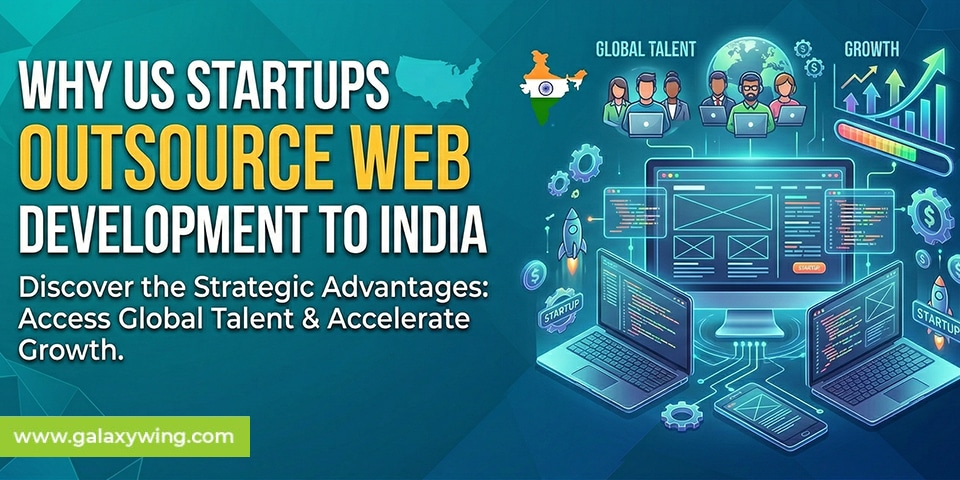
US companies save 60-70% by outsourcing to India while accessing a talent pool of 5 million+ developers. Hire developers from Galaxywing.
The average US startup burns through 70% of its seed funding within the first 18 months. For most, engineering salaries are the single largest line item. That is exactly why a growing number of American founders choose to outsource web development to India — not as a shortcut, but as a strategic move that stretches runway while accessing world-class technical talent.
If you are a startup founder or CTO weighing this decision, this guide breaks down the real numbers, the genuine advantages, the risks you need to watch for, and how to choose a partner who will actually deliver.
Let us start with what drives most of these conversations — money. The cost differential between hiring developers in the United States and India is significant, and it is not a marginal difference.
According to data from Glassdoor, Indeed, and Clutch (as of early 2026), the average hourly rate for a mid-level full-stack web developer in the US ranges from $120 to $180 per hour at agencies, or an annual salary of $110,000 to $160,000 for a full-time hire (before benefits, equity, and overhead). In India, a developer of comparable skill level at a reputable firm charges between $25 and $50 per hour.
That is not a small gap. It is a 3x to 5x cost multiplier.
| Cost Factor | United States | India | Savings |
|---|---|---|---|
| Agency Hourly Rate (Mid-Level) | $120 – $180/hr | $25 – $50/hr | 60% – 80% |
| Senior Full-Stack Developer (Annual) | $140,000 – $180,000 | $30,000 – $55,000 | 65% – 78% |
| React/Node.js Developer (Annual) | $120,000 – $160,000 | $25,000 – $45,000 | 70% – 80% |
| DevOps Engineer (Annual) | $130,000 – $170,000 | $28,000 – $50,000 | 70% – 78% |
| QA/Test Engineer (Annual) | $90,000 – $120,000 | $15,000 – $30,000 | 75% – 83% |
| MVP Build (3-Month Project) | $80,000 – $150,000 | $20,000 – $45,000 | 65% – 75% |
| Full-Time Team (5 developers, 1 year) | $650,000 – $900,000 | $150,000 – $275,000 | 69% – 77% |
For a seed-stage startup with $1.5M in funding, the difference between a US-based team and an Indian outsourcing partner could mean an extra 12 to 18 months of runway. That is often the difference between finding product-market fit and running out of money.
Cost savings alone do not justify outsourcing. If the work is subpar, you have saved nothing — you have just delayed your problems. So why has India specifically become the global hub for outsourced web development?
India produces roughly 1.5 million engineering graduates every year. Its top institutions — the IITs, NITs, BITS Pilani, and IIIT Hyderabad — are globally ranked and fiercely competitive. Cities like Bangalore, Hyderabad, Pune, and Chennai have mature tech ecosystems that rival mid-tier US tech hubs in density and specialization.
This means when you outsource web development to India, you are not fishing in a shallow pond. You have access to specialists across the entire modern stack: React, Angular, Vue, Node.js, Python, Django, Ruby on Rails, Laravel, AWS, Azure, GCP, Kubernetes, and everything in between.
India is the world’s second-largest English-speaking country. English is the primary language of higher education, business, and the IT industry across the country. Unlike some other outsourcing destinations, communication barriers with Indian development teams are minimal — particularly at reputable firms that serve international clients.
That said, accents and communication styles can differ. The best outsourcing partners invest in communication training and assign dedicated project managers who bridge any cultural gaps.
India Standard Time (IST) is 9.5 to 12.5 hours ahead of US time zones. On paper, that looks like a problem. In practice, it creates a powerful workflow advantage.
Indian teams working a standard 9 AM to 6 PM IST schedule overlap with US East Coast mornings (roughly 10:30 PM to 8:30 AM EST becomes their full workday). Many Indian firms also offer flexible hours, with teams starting later to create a 3 to 4 hour real-time overlap with US business hours.
The result: you brief your team at the end of your US workday, and by the time you open your laptop the next morning, substantial progress has been made. This “follow-the-sun” model effectively gives your project near-24-hour development cycles.
Here is where honest conversation matters. The quality of Indian development firms varies enormously — just as it does in the United States. There are elite shops producing Fortune 500-grade work, and there are low-cost mills cutting corners at every turn.
The best Indian web development teams:
The firms to avoid typically promise unrealistically low rates (under $15/hour), have no verifiable portfolio, and lack any structured development process. Price is a signal: if a rate seems too good to be true, the quality almost certainly reflects that.
No article on outsourcing is complete without an honest look at what can go wrong. Here are the most common challenges US startups face when they outsource web development to India, along with practical mitigation strategies.
The Risk: You hire a firm based on a polished portfolio, only to discover the senior developers who impressed you during the sales process are not the ones working on your project.
Mitigation: Insist on interviewing the actual developers who will work on your project. Include a paid trial period (2 to 4 weeks) before committing to a long-term engagement. Review code output from the first sprint before proceeding.
The Risk: Misunderstandings around requirements, scope, and priorities. A tendency in some Indian work cultures to say “yes” even when the requirement is unclear.
Mitigation: Require detailed written specifications before every sprint. Use daily standups (even 15-minute async video updates). Establish a culture where asking clarifying questions is rewarded, not penalized. A dedicated project manager on the outsourcing side is essential, not optional.
The Risk: Concern about code ownership, IP protection, and data handling in a different legal jurisdiction.
Mitigation: Execute a robust NDA and a Master Service Agreement (MSA) that explicitly assigns all IP to your company. Work with firms that hold SOC 2 or ISO 27001 certifications. Use your own source control repositories (GitHub, GitLab) so code never lives on the vendor’s infrastructure.
The Risk: Critical decisions get delayed because key people are asleep on the other side of the world.
Mitigation: Establish a mandatory overlap window (at least 2 to 3 hours) where both teams are online simultaneously. Use this window for synchronous communication; use async tools (Loom, Slack, documented tickets) for everything else.
The Risk: The quoted rate is low, but project management overhead, rework cycles, and coordination costs erode the savings.
Mitigation: Budget for a 15% to 20% management overhead on top of raw development costs. Even with this buffer, the savings remain substantial (50% to 65% compared to a fully US-based team). Choose a partner that includes project management in their engagement model.
After working through hundreds of outsourcing engagements, the following criteria separate partners who deliver from those who disappoint.
The most successful outsourcing engagements we see today follow a hybrid model: a small US-based team handles product strategy, architecture decisions, and client-facing work, while a larger India-based team handles core development, testing, and DevOps.
This model works because it places strategic control close to the business while leveraging India’s cost and talent advantages for execution. It is the approach used by companies ranging from early-stage startups to publicly traded tech firms.
When you hire developers through a partner with both US and Indian operations, you get local accountability with offshore efficiency — a combination that pure offshore or pure onshore models cannot match.
In the interest of giving you a complete picture, here are scenarios where outsourcing web development to India may not be the right move:
For most US startups building web applications, SaaS platforms, mobile backends, or e-commerce solutions, outsourcing remains a strategically sound decision when executed with the right partner.
The decision to outsource web development to India is no longer a fringe tactic or a last resort for cash-strapped startups. It is a mainstream strategy employed by companies at every stage, from bootstrapped founders to Series C enterprises.
The math is straightforward: 60% to 80% cost savings, access to one of the world’s deepest engineering talent pools, near-24-hour development cycles, and a mature outsourcing ecosystem refined over two decades. The risks are real but manageable with proper due diligence, clear contracts, and structured communication.
The key is choosing the right partner — one that combines technical excellence with transparent processes and a genuine understanding of the US startup landscape.
Galaxywing IT Solutions operates from offices in both the United States and India, giving you the hybrid advantage: local project oversight with access to top-tier Indian engineering talent at competitive rates.
Whether you need a dedicated development team, staff augmentation, or end-to-end product development, we help US startups ship faster and smarter.
Explore our developer hiring models | Schedule a free consultation

In today’s fast-paced, technology-driven world, staying ahead of the competition requires more than just keeping up—it means leading with innovation. At Galaxywing IT Solutions, we provide the adva...
Read More

User experience (UX) is a critical component of any successful website. A well-designed UX can lead to higher engagement, better customer satisfaction, and increased conversions. Evaluating your we...
Read More 
AI is no longer just an assistive tool in web development—it’s a co-creator, a strategist, and a real-time decision-maker. In 2025, artificial intelligence has fundamentally altered how websites an...
Read More 
In the ever-evolving digital landscape, Artificial Intelligence (AI) has emerged as a game-changer in website design and development. Businesses and developers are now leveraging AI to create visua...
Read More 
n today’s digital world, simply having a website isn’t enough. You need a website that serves your business, engages your visitors, and converts traffic into action. The right website is more than ...
Read More 
In today’s competitive landscape, leveraging the right technology is paramount for business success. Off-the-shelf IT solutions often fall short when it comes to addressing the unique challenges an...
Read More At our core, we are dedicated to helping businesses flourish and achieve extraordinary sales growth. With over a decade of experience, we have been instrumental in empowering numerous organizations to thrive in their respective industries. What started as a small team with a modest vision has evolved into a formidable force of passionate professionals who are committed to design and excellence.
Since our establishment in 2015, we have consistently delivered exceptional results. Our team’s expertise, combined with our unwavering dedication, has enabled us to make a significant impact on the success of our clients. We understand the unique challenges businesses face and tailor our strategies and solutions to drive remarkable growth.
Our approach is built on collaboration, innovation, and a deep understanding of our clients’ goals. We work closely with businesses to develop customized strategies and implement cutting-edge solutions that yield tangible results. By leveraging our expertise, industry knowledge, and a relentless pursuit of excellence, we help businesses thrive in today’s competitive landscape.
As we look ahead, our commitment to helping businesses grow better remains unwavering. We will continue to evolve, adapt, and push boundaries to deliver even greater value to our clients. Together, let’s embark on a journey of growth, success, and unparalleled achievement.
Join us as we empower businesses to reach new heights of excellence.


 By Galaxywing IT Solutions
  Mar 24, 2026