


USA


Australia
USA
Australia
Our blog shares both our expertise and bit of company culture.
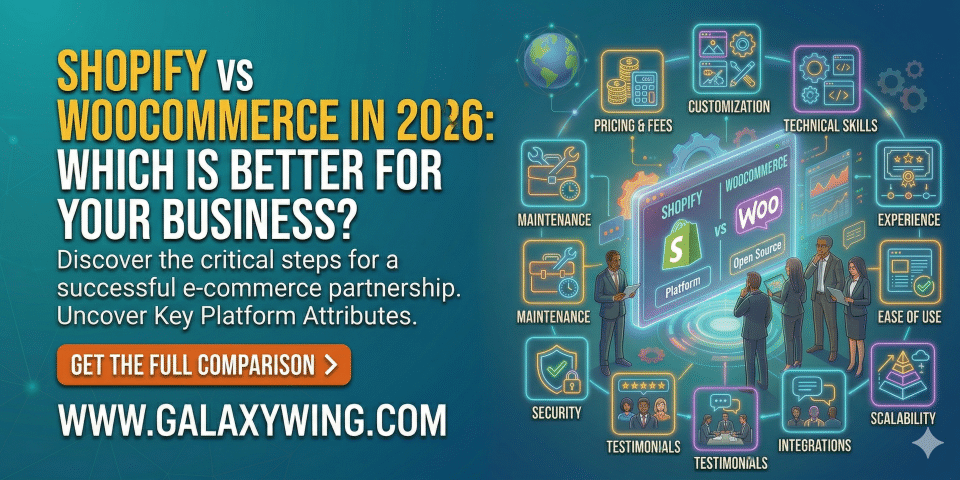
If you are a US business owner ready to launch an online store in 2026, you have almost certainly narrowed your platform search down to two names: Shopify and WooCommerce. These two platforms power the vast majority of eCommerce websites worldwide, and for good reason. Both are capable, proven, and backed by massive ecosystems of developers, themes, and integrations.
But choosing between them is not as simple as picking the more popular one. The right platform depends on your budget, technical skills, growth plans, and the kind of shopping experience you want to deliver. In this comprehensive Shopify vs WooCommerce 2026 comparison, we break down every factor that matters so you can make a confident, well-informed decision.
Shopify is a fully hosted, all-in-one eCommerce platform. You pay a monthly subscription, and Shopify handles everything: hosting, security, SSL certificates, software updates, and payment processing. You build your store using their drag-and-drop editor, choose from hundreds of themes, and add functionality through the Shopify App Store. As of 2026, Shopify powers over 4.8 million online stores globally and continues to roll out AI-powered features, faster checkout experiences, and expanded B2B capabilities.
WooCommerce is a free, open-source eCommerce plugin for WordPress. It turns any WordPress website into a fully functional online store. Because it is open source, you have complete control over your code, your data, and your hosting environment. WooCommerce powers roughly 36 percent of all online stores worldwide, making it the single most-used eCommerce platform by installation count. However, “free” comes with caveats: you are responsible for hosting, security, updates, and performance optimization.
The table below provides a side-by-side breakdown of the most important factors US business owners should consider when choosing between Shopify and WooCommerce in 2026.
| Feature | Shopify | WooCommerce |
|---|---|---|
| Pricing | Starts at $39/month (Basic plan). Advanced plan is $399/month. Shopify Plus starts at $2,300/month for enterprise. Transaction fees apply unless you use Shopify Payments. | The plugin is free. You pay for hosting ($10 – $50/month for shared, $30 – $200/month for managed WordPress hosting), a domain ($10 – $20/year), SSL ($0 – $100/year), and premium extensions ($50 – $300 each). Total first-year cost typically ranges from $500 to $3,000+. |
| Ease of Use | Extremely beginner-friendly. No coding required. The drag-and-drop store builder, guided setup wizard, and intuitive dashboard make it possible to launch a store in a single afternoon. | Requires more technical knowledge. You need to set up WordPress, install WooCommerce, configure hosting, manage updates, and handle security. Not difficult for someone comfortable with WordPress, but steeper learning curve for true beginners. |
| Customization | Good customization within the Shopify ecosystem. Liquid templating language allows theme-level changes. Shopify Functions and Checkout Extensibility APIs offer deeper customization. However, you are ultimately working within Shopify’s framework. | Virtually unlimited customization. Because WooCommerce is open source and built on WordPress, you can modify every line of code, build custom plugins, alter the database, and create any feature you can imagine. This is the platform’s greatest strength. |
| SEO Capabilities | Solid built-in SEO. Supports custom title tags, meta descriptions, alt text, canonical URLs, sitemap generation, and clean URL structures. However, URL structures are somewhat rigid (e.g., /collections/ and /products/ prefixes cannot be removed). | Excellent SEO potential. With plugins like Yoast SEO or Rank Math, you get granular control over every SEO element. Full control over URL structures, schema markup, page speed optimization, and technical SEO. WordPress has been the gold standard for content-driven SEO for years. |
| Site Speed | Fast out of the box. Shopify uses a global CDN, optimized servers, and built-in caching. Average load times are consistently under 2 seconds. You do not need to worry about server configuration. | Speed depends entirely on your hosting, theme, and plugin choices. A well-optimized WooCommerce store on premium hosting can be extremely fast. A poorly configured one on cheap shared hosting can be painfully slow. Requires ongoing performance management. |
| Payment Options | Shopify Payments (powered by Stripe) is the default. Supports 100+ third-party payment gateways including PayPal, Amazon Pay, Apple Pay, and Google Pay. Using third-party gateways incurs an additional 0.5% – 2% transaction fee. | Supports virtually every payment gateway through extensions. WooCommerce Payments (also Stripe-based) is free to use. PayPal, Square, Authorize.Net, and dozens of others available. No platform-imposed transaction fees beyond what your gateway charges. |
| Scalability | Handles high traffic and large catalogs effortlessly. Shopify Plus is built for enterprise-scale operations processing millions in revenue. Infrastructure scaling is managed entirely by Shopify. | Can scale to enterprise level, but requires investment in hosting infrastructure, caching solutions, database optimization, and potentially a dedicated DevOps resource. Scaling is your responsibility. |
| Themes | Over 200 official themes (13 free, the rest $180 – $400). All themes are mobile-responsive and reviewed for quality by Shopify. Third-party themes available from marketplaces like ThemeForest. | Thousands of free and premium themes available. Quality varies widely. Popular premium themes (Astra, Flatsome, Flavor) cost $50 – $80. Full control to build completely custom themes from scratch. |
| Plugins and Extensions | Over 10,000 apps in the Shopify App Store. Many are subscription-based ($5 – $100+/month), which can add up. Apps are vetted by Shopify for quality and security. | Over 60,000 WordPress plugins plus 800+ WooCommerce-specific extensions. Many are free. Premium plugins are typically one-time purchases or annual licenses ($50 – $200). Quality and security vary; due diligence is needed. |
| Customer Support | 24/7 support via live chat, email, and phone. Extensive documentation, community forums, and Shopify Academy. Shopify Plus merchants get dedicated account managers. | No official support line. You rely on WordPress.org forums, WooCommerce documentation, your hosting provider’s support team, and the broader WordPress community. Many hosting companies offer WooCommerce-specific support tiers. |
Pricing is often the deciding factor for US business owners, so let us go deeper on the real costs you should expect in 2026.
On top of the subscription, budget for a premium theme ($180 – $400 one-time), apps ($50 – $300/month depending on your stack), and potentially a Shopify developer for custom work. A realistic first-year budget for a small to mid-size Shopify store is $2,000 to $8,000.
A realistic first-year budget for a small to mid-size WooCommerce store is $500 to $5,000, depending heavily on your hosting choice and how many premium extensions you need. The ongoing cost in subsequent years tends to be lower than Shopify because many plugin licenses are one-time purchases or affordable annual renewals.
Search engine visibility can make or break your online store. Both platforms are SEO-capable, but they approach it differently.
Shopify has made significant SEO improvements over the years. In 2026, it supports custom meta tags, automatic sitemaps, 301 redirects, canonical tags, and structured data. Shopify’s built-in speed optimization and CDN give it a strong Core Web Vitals foundation. However, some SEO professionals still point to limitations: rigid URL structures, limited blogging capabilities compared to WordPress, and fewer options for advanced technical SEO configurations.
WooCommerce, built on WordPress, has always been the SEO leader. WordPress was designed for content, and plugins like Yoast SEO and Rank Math provide an unmatched level of SEO control. You can customize URL structures, implement complex schema markup, create content-rich category pages, manage internal linking strategies with precision, and publish a full-featured blog that lives natively alongside your store. If organic search is a primary customer acquisition channel for your business, WooCommerce gives you more tools to work with.
Verdict on SEO: WooCommerce has the edge for businesses that rely heavily on content marketing and organic search. Shopify is perfectly adequate for most stores, especially those that depend more on paid advertising and social commerce.
Page speed directly impacts conversion rates. Research consistently shows that every additional second of load time reduces conversions by 7 percent or more.
Shopify wins on consistency. Because Shopify controls the hosting infrastructure, every store benefits from enterprise-grade servers, a global CDN, automatic image optimization, and built-in caching. You do not need to think about server configuration, and performance is reliably fast across all plans.
WooCommerce wins on potential ceiling. A WooCommerce store on optimized managed hosting (like Cloudways, Kinsta, or WP Engine) with proper caching, a lightweight theme, and image optimization can achieve sub-one-second load times. But it takes effort, knowledge, and the right hosting investment. Without that investment, WooCommerce stores are often slower than their Shopify counterparts.
Shopify is the right choice for your business if the following describes your situation:
Shopify is particularly well-suited for direct-to-consumer brands, dropshipping businesses, and product-focused companies that want a polished, professional storefront without heavy technical overhead.
WooCommerce is the right choice for your business if the following describes your situation:
WooCommerce is particularly well-suited for content-driven brands, businesses with complex product catalogs, B2B operations with custom pricing, and companies that want to build a unique, differentiated online experience.
A growing trend in 2026 is headless commerce, where the front end of your store is decoupled from the back end. Both Shopify and WooCommerce support headless architectures.
Shopify offers Hydrogen and Oxygen, its headless commerce framework and hosting solution, built on React. This allows developers to create ultra-fast, fully custom storefronts while still using Shopify’s back-end infrastructure for inventory, payments, and order management.
WooCommerce exposes a REST API and supports GraphQL, making it compatible with any front-end framework including Next.js, Gatsby, and Nuxt. The open-source nature of WooCommerce makes headless implementations more flexible but also more complex to set up.
If you are considering a headless approach, either platform can work. The choice often comes down to your development team’s preferences and your long-term architecture strategy.
Security is non-negotiable for any online store handling customer payment information.
Shopify handles all security for you. Every store is PCI DSS Level 1 compliant out of the box. SSL certificates are automatic. Software updates are applied by Shopify. You never need to worry about security patches or vulnerability scanning.
WooCommerce puts security in your hands. You are responsible for keeping WordPress core, WooCommerce, themes, and all plugins updated. You need to implement SSL, use a firewall plugin or service, run regular malware scans, and ensure your hosting environment is properly configured. Managed WordPress hosts like WP Engine and Kinsta handle much of this, but it is still something you need to actively manage.
For businesses without a dedicated technical resource, Shopify’s managed security is a significant advantage and a strong reason to choose the platform.
There is no universally “better” platform. The right choice depends entirely on your business needs, technical capabilities, and growth strategy.
Choose Shopify if you want an all-in-one, managed solution that lets you focus entirely on selling. It is the better choice for non-technical business owners, fast-growing DTC brands, and companies that value simplicity and reliability over maximum customization. Shopify is especially strong for multi-channel selling and businesses that need to launch quickly.
Choose WooCommerce if you want maximum control, flexibility, and ownership of your online store. It is the better choice for content-driven businesses, companies with complex or unique requirements, budget-conscious entrepreneurs, and anyone already invested in the WordPress ecosystem. WooCommerce is especially strong for SEO, content marketing, and businesses with specialized product types.
If you are still unsure, ask yourself this simple question: Do I want to rent my store, or do I want to own it? Shopify is renting a premium, fully furnished apartment. WooCommerce is buying a house and renovating it to your exact specifications. Both can be wonderful places to do business.
At Galaxywing, we have helped hundreds of US businesses launch and grow successful online stores on both Shopify and WooCommerce. Our team of eCommerce specialists can help you evaluate which platform is right for your business, design a high-converting storefront, and set up everything from payment processing to shipping integrations.
If you are leaning toward Shopify, our Shopify development services cover everything from custom theme development to Shopify Plus migrations, app integrations, and ongoing store optimization. We build Shopify stores that look great, load fast, and convert visitors into customers.
Whether you choose Shopify, WooCommerce, or need guidance on the right path forward, we are here to help you succeed. Contact the Galaxywing team today for a free consultation and let us build the online store your business deserves.
Yes, Shopify is generally better for beginners. It is an all-in-one platform that handles hosting, security, and updates automatically. You do not need any technical skills to set up and manage a Shopify store. WooCommerce requires familiarity with WordPress and a willingness to manage your own hosting and software updates.
The WooCommerce plugin itself is free to download and install. However, you will need to pay for web hosting, a domain name, an SSL certificate, and likely some premium plugins or extensions. The total cost of running a WooCommerce store typically ranges from $500 to $5,000 per year depending on your needs.
WooCommerce has a slight edge for SEO because it is built on WordPress, which offers unmatched flexibility for content marketing, URL structure customization, and technical SEO. However, Shopify has made significant SEO improvements and is more than adequate for most online stores.
Yes, migration is possible in both directions. Tools exist to transfer products, customers, and order history between platforms. However, migration can be complex and time-consuming, which is why choosing the right platform from the start is important. If you need help migrating, contact Galaxywing for professional migration assistance.
WooCommerce does not charge any platform transaction fees. You only pay the fees charged by your payment gateway (typically 2.9% + $0.30 per transaction for Stripe or PayPal). Shopify charges 0.5% to 2% on top of gateway fees unless you use Shopify Payments, which has its own competitive processing rates.
Both can handle large catalogs, but the approach differs. Shopify handles scaling automatically through its managed infrastructure. WooCommerce can scale equally well but requires investment in quality hosting, database optimization, and caching solutions. For large stores without a technical team, Shopify is often the simpler choice.
You have a SaaS idea that keeps you up at night. You have sketched it on napkins, pitched it to friends, and maybe even started a slide deck. But the gap between idea and live product feels enormou...
Read More

In the modern digital landscape, businesses strive to expand their audience and stay ahead of the competition. One effective approach to achieve these goals is through cross-platform app developmen...
Read More 
Google's Quality Rater Guidelines play a vital role in shaping the search engine's algorithms and ensuring the delivery of high-quality, relevant search results. These guidelines help human quality...
Read More 
In the ever-evolving landscape of online marketing, Pay Per Click (PPC) ads have emerged as a dynamic and influential tool for businesses seeking rapid growth and enhanced visibility. As we delve i...
Read More 
Discover how businesses across the US are slashing customer support expenses while improving satisfaction scores — and how you can do the same. Customer support is one of the largest operational...
Read More 
A website is crucial for a business for several reasons: Online Presence: In today's digital age, having an online presence is essential for businesses to reach and engage with customers. A we...
Read More At our core, we are dedicated to helping businesses flourish and achieve extraordinary sales growth. With over 15 years of experience, we have been instrumental in empowering numerous organizations to thrive in their respective industries. What started as a small team with a modest vision has evolved into a passionate team of professionals committed to design and delivering results.
Our approach is built on collaboration, innovation, and a deep understanding of our clients’ goals. We work closely with businesses to develop customized strategies and implement solutions that yield tangible results. We understand the unique challenges businesses face and tailor our approach to drive meaningful growth.
As we look ahead, our commitment to helping businesses grow remains strong. We will continue to evolve, adapt, and deliver even greater value to our clients. Together, let’s embark on a journey of growth and success.


 By Galaxywing IT Solutions
  Apr 4, 2026