


USA


Australia
USA
Australia
Our blog shares both our expertise and bit of company culture.
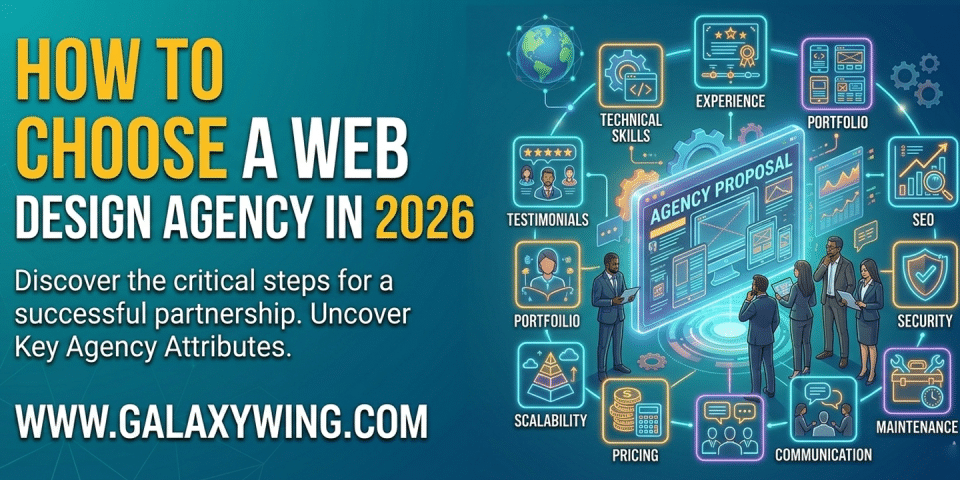
Your website is the front door to your business. Picking the wrong agency to build it can cost you months of lost revenue. Here are the 10 factors every small business owner should evaluate before signing a contract.
If you are a small business owner in the United States, your website is likely the first impression a potential customer has of your brand. It needs to load fast, look professional, work flawlessly on mobile, and convert visitors into paying customers. That is a tall order — and it is exactly why hiring the right web design agency matters so much.
But with thousands of agencies, freelancers, and offshore shops all competing for your budget, figuring out how to choose a web design agency that actually delivers results can feel overwhelming. Some promise the world for $500. Others charge $50,000 and still miss deadlines. The difference between a good agency and a bad one is not always obvious from a homepage and a sales call.
This guide breaks down the 10 most important factors to evaluate before you hand over your deposit. Whether you are launching your first website or redesigning an existing one, these checks will help you avoid costly mistakes and find a partner who treats your business like their own.
The stakes are higher in 2026 than they have ever been. Google’s algorithm updates now heavily penalize slow, poorly structured, and inaccessible websites. Consumers expect sub-two-second load times on mobile. Privacy regulations are tightening. And your competitors are investing more in their digital presence every quarter.
A poorly built website does not just look bad — it actively loses you money. Studies show that 75% of consumers judge a company’s credibility based on its website design. A single second of extra load time can reduce conversions by 7%. And if your site is not accessible, you face legal exposure under the ADA.
The agency you choose will shape all of these outcomes. So let us walk through exactly what to look for.
The single most important thing you can do when evaluating any web design agency is to look at their actual work. Not stock screenshots on their homepage — real, live websites you can click through and test on your own phone.
Here is what to look for when reviewing a portfolio:
If an agency cannot show you at least five strong, live examples of their work, that is a red flag worth taking seriously.
Vague pricing is one of the most common complaints small business owners have about web design agencies. You ask for a quote and get a range so wide it is meaningless: “Somewhere between $3,000 and $30,000 depending on requirements.” That is not a quote — that is a guess.
A reputable agency should be able to provide:
If an agency gets defensive or evasive when you ask about cost breakdowns, walk away. You are about to enter a business relationship that requires trust, and pricing transparency is the first test of that trust.
Web design projects live and die on communication. A talented design team that takes five days to respond to emails or never provides project updates will cause you more stress than a less flashy team that communicates clearly and consistently.
During your initial conversations, pay attention to:
Strong communication is not a nice-to-have — it is arguably the most important factor in whether your project finishes on time and on budget.
Here is a truth most agencies do not advertise: launching a website is not the finish line. It is the starting line. After your site goes live, you will need ongoing support for bug fixes, security updates, content changes, plugin updates, performance monitoring, and new feature requests.
Before signing anything, ask these questions:
Some agencies build the site, hand you the keys, and disappear. Others offer comprehensive maintenance packages that keep your site secure, updated, and performing at its best. You want the latter — especially if you do not have an in-house technical team.
A beautiful website that nobody can find on Google is an expensive digital brochure. Search engine optimization needs to be built into your website from the foundation up — not bolted on as an afterthought.
When learning how to choose a web design agency, testing their SEO knowledge is non-negotiable. Ask them to explain their approach to:
If an agency says “we’ll handle the SEO” but cannot articulate specifics, they are probably just installing a plugin and calling it a day. That is not SEO — that is checkbox marketing.
In 2026, more than 65% of all web traffic in the United States comes from mobile devices. If your website is designed for desktop first and then “made responsive” as an afterthought, your mobile visitors — who are now the majority — are getting a compromised experience.
A mobile-first approach means the agency designs for the smallest screen first, then progressively enhances the layout for tablets and desktops. This ensures:
Ask the agency to show you mobile versions of their recent projects. Pull them up on your phone during the call. If the sites feel clunky, slow, or hard to navigate on mobile, the agency is not truly mobile-first regardless of what their sales pitch claims.
Every small business owner wants their website done yesterday. But a quality website takes time, and any agency that promises a complete custom site in two weeks is either cutting corners or outsourcing the work to someone who will.
A realistic timeline for a custom small business website typically looks like this:
That is roughly 8 to 13 weeks for a standard small business website. More complex projects with e-commerce, custom portals, or integrations will take longer. The key is that the agency provides a timeline with clear milestones and built-in review periods where you give feedback before they proceed to the next phase.
Online reviews are one of the most reliable ways to gauge an agency’s real performance. But you need to look in the right places and ask the right questions.
Start with these sources:
Beyond online reviews, ask the agency for two or three client references you can actually contact. When you speak with references, ask about the agency’s communication, whether the project stayed on budget, how they handled unexpected issues, and whether the client would hire them again. The answers to these questions tell you more than any portfolio ever could.
The technology your website is built on has long-term implications for performance, scalability, security, and maintenance costs. You need to understand what the agency builds with and why.
Common platforms and when they make sense:
The right tech stack depends on your specific needs. But here is the critical question: will you own the code and content when the project is done? Some agencies build on proprietary platforms that lock you in. If you ever leave, you lose everything. Always confirm in writing that you retain full ownership of all code, content, design assets, and data.
The contract is where promises either become binding commitments or dissolve into vague intentions. Before you sign, review every clause — and if the agency does not provide a written contract, do not proceed.
Key terms to look for:
If you are not comfortable reviewing contracts yourself, spend a few hundred dollars having a business attorney review it. That small investment can protect you from thousands of dollars in disputes down the road.
While the 10 checks above help you identify a strong agency, there are also warning signs that should stop you in your tracks:
Knowing how to choose a web design agency comes down to doing your homework before committing your budget. Talk to at least three agencies. Compare proposals side by side. Check references. Test their communication. And trust your instincts — if something feels off during the sales process, it will only get worse once the project starts.
The right agency will feel like a partner, not a vendor. They will ask smart questions about your business, challenge your assumptions when needed, explain their process clearly, and make you feel confident that your investment will generate real returns.
Your website is too important to leave to chance. Take the time to evaluate your options thoroughly, and you will end up with a digital presence that drives growth for years to come.
At Galaxywing IT Solutions, we have helped businesses across the United States build websites that are fast, mobile-first, SEO-optimized, and designed to convert visitors into customers. We believe in pricing transparency, clear communication, and long-term partnerships — not one-and-done projects.
Whether you are launching a new site or redesigning an existing one, our team will guide you through every step — from strategy and design to development, launch, and ongoing support.
Now that you know how to choose a web design agency, let us show you why Galaxywing is the right choice.

Transform Your Business with Cutting-Edge IT Services In today’s fast-paced digital landscape, staying ahead requires more than just keeping up—it demands innovation, agility, and a robust IT st...
Read More

In today’s digital age, your website is the face of your business. It’s where first impressions are made — and often, where potential customers decide whether to trust your brand or move on. Unf...
Read More 
In today’s fast-paced, technology-driven world, staying ahead of the competition requires more than just keeping up—it means leading with innovation. At Galaxywing IT Solutions, we provide the adva...
Read More 
If you are a US business owner ready to launch an online store in 2026, you have almost certainly narrowed your platform search down to two names: Shopify and WooCommerce. These two platforms power...
Read More 
Artificial Intelligence (AI) is rapidly becoming the backbone of modern IT growth strategies. Companies across the IT sector are leveraging AI to improve efficiency, reduce operational costs, enhan...
Read More 
In today's fast-paced digital age, the demand for innovative mobile applications is skyrocketing. Whether you're an entrepreneur with a groundbreaking idea or a business looking to expand your digi...
Read More At our core, we are dedicated to helping businesses flourish and achieve extraordinary sales growth. With over 15 years of experience, we have been instrumental in empowering numerous organizations to thrive in their respective industries. What started as a small team with a modest vision has evolved into a passionate team of professionals committed to design and delivering results.
Our approach is built on collaboration, innovation, and a deep understanding of our clients’ goals. We work closely with businesses to develop customized strategies and implement solutions that yield tangible results. We understand the unique challenges businesses face and tailor our approach to drive meaningful growth.
As we look ahead, our commitment to helping businesses grow remains strong. We will continue to evolve, adapt, and deliver even greater value to our clients. Together, let’s embark on a journey of growth and success.


 By Galaxywing IT Solutions
  Apr 4, 2026