


USA


Australia
USA
Australia
Our blog shares both our expertise and bit of company culture.
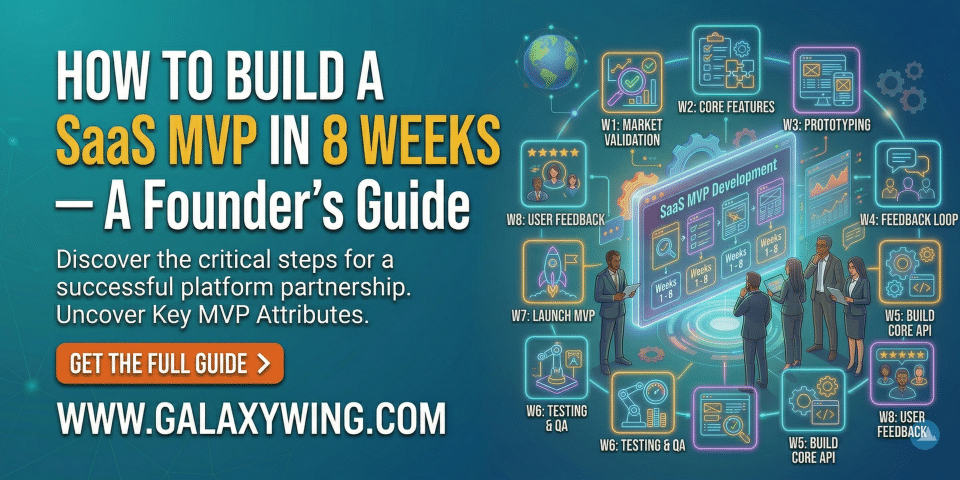
You have a SaaS idea that keeps you up at night. You have sketched it on napkins, pitched it to friends, and maybe even started a slide deck. But the gap between idea and live product feels enormous. Here is the truth most successful founders already know: you do not need a perfect product to launch. You need a minimum viable product. And if you plan it right, you can build one in just eight weeks.
This guide walks you through exactly how to build a SaaS MVP from scratch — week by week, step by step — so you can go from concept to paying customers without burning through your entire runway. Whether you are bootstrapping or backed by investors, this framework will help you launch faster, spend smarter, and learn sooner.
A SaaS MVP (Minimum Viable Product) is the simplest version of your software-as-a-service product that delivers enough value to attract early users and generate real feedback. It is not a prototype or a demo. It is a working product with just enough features to solve a core problem for a specific audience.
The goal is not perfection. The goal is validated learning. Every week your product sits in development limbo is a week you are not learning from actual users. An MVP lets you:
Companies like Dropbox, Airbnb, and Slack all started with stripped-down MVPs. If it worked for them, it can work for you. The key is knowing how to build a SaaS MVP the right way — lean, focused, and fast.
Before you write a single line of code, you need to confirm that people actually want what you are building. Skipping validation is the most expensive mistake a founder can make. Here is how to validate quickly:
Identify 15 to 20 people who fit your target customer profile. Reach out via LinkedIn, industry forums, or your personal network. Ask open-ended questions about their pain points, current solutions, and willingness to pay. Do not pitch your product yet — listen first.
Research existing solutions in your space. If competitors exist, that is actually a good sign — it means there is demand. Your job is to find a gap: an underserved niche, a better user experience, a lower price point, or a unique integration that competitors have overlooked.
Write a single sentence that explains what your product does, who it serves, and why it is better than existing alternatives. If you cannot do this clearly, go back to the drawing board. This sentence will guide every decision you make over the next seven weeks.
Build a simple landing page that describes your product and collects email signups. Drive traffic to it through targeted ads or social media posts. If people sign up, you have early evidence of demand. If they do not, you have saved yourself months of wasted effort.
This is where most founders go wrong. They try to build everything at once. Instead, you need to ruthlessly prioritize. Your MVP should include only the features that are absolutely essential to delivering your core value proposition.
Categorize every feature idea into four buckets:
For each must-have feature, map out the exact steps a user takes from start to finish. This exercise exposes hidden complexity early and helps your development team estimate timelines accurately. Keep flows simple — three to five steps per feature is ideal for an MVP.
Frame each feature as a user story: “As a [type of user], I want to [action] so that I can [benefit].” This keeps the focus on user value rather than technical implementation details. Aim for 8 to 12 user stories for your MVP — any more and you are probably over-scoping.
Your tech stack should be driven by speed, scalability, and the availability of developers — not by what is trendy on Hacker News. Here are proven combinations for SaaS MVPs:
| Layer | Recommended Options | Why |
|---|---|---|
| Frontend | React, Next.js, or Vue.js | Large ecosystem, fast development, easy to hire for |
| Backend | Node.js, Python (Django/FastAPI), or Ruby on Rails | Rapid prototyping, extensive libraries, strong community support |
| Database | PostgreSQL or MongoDB | PostgreSQL for relational data, MongoDB for flexible schemas |
| Hosting | AWS, Google Cloud, or Vercel | Scalable infrastructure with startup-friendly pricing tiers |
| Authentication | Auth0, Firebase Auth, or Clerk | Saves weeks of development time on login and user management |
| Payments | Stripe | Industry standard for SaaS billing, subscriptions, and invoicing |
A word of advice: do not build from scratch what you can buy or integrate. Authentication, payments, email delivery, and file storage all have battle-tested third-party solutions. Use them. Your competitive advantage is not in reinventing login screens — it is in solving your customer’s problem better than anyone else.
Good design is not optional, even for an MVP. Users form opinions about your product within seconds, and a confusing interface will kill adoption faster than missing features. That said, you do not need pixel-perfect designs. You need clear, functional, and intuitive interfaces.
Sketch low-fidelity wireframes for every screen in your user flows. Tools like Figma, Whimsical, or even pen and paper work perfectly. Focus on layout, navigation, and information hierarchy — not colors or fonts.
Choose a UI component library like Tailwind CSS, Shadcn/UI, or Material UI. This gives you a consistent look and feel out of the box and dramatically reduces design-to-code time. Pick one and stick with it — do not mix frameworks.
The first five minutes of a user’s experience determine whether they stick around or churn. Design a smooth onboarding flow that gets users to their first “aha moment” as quickly as possible. If your product helps teams manage projects, the onboarding should end with the user looking at their first project board — not staring at an empty dashboard.
Share your wireframes or clickable prototypes with five to ten potential users. Watch them navigate. Note where they hesitate or get confused. Fix those issues now, when changes cost minutes instead of days.
This is the core development phase. With your features defined, tech stack chosen, and designs ready, your team can move fast. Here is how to structure the four-week development sprint:
Set up the development environment, CI/CD pipeline, database schema, and authentication system. Deploy a skeleton application to your staging environment. This “walking skeleton” approach ensures that deployment and infrastructure issues are resolved early, not the night before launch.
Build the two or three features that define your product’s core value. This is where 70 percent of your development effort should go. If you are building a project management tool, this means task creation, assignment, and status tracking. Everything else is secondary.
Add supporting features like notifications, user settings, billing integration, and any third-party connections (Slack, email, calendars). Wire up your payment system with Stripe or a similar provider. Set up transactional emails for account creation, password resets, and key product actions.
Refine the user interface, fix bugs identified during development, optimize page load speeds, and ensure the application is responsive across devices. Add error handling, loading states, and empty states — the small details that make a product feel professional rather than half-baked.
Testing is not a phase you can skip or rush. A buggy MVP will generate the wrong kind of feedback — complaints about broken features instead of insights about product-market fit.
Launch day is not the finish line — it is the starting line. Your goal is to get the product into users’ hands and start the feedback loop. Here is a practical launch checklist:
Do not aim for a massive launch. Aim for a focused launch with 50 to 200 engaged early adopters who will give you honest, detailed feedback. That feedback is worth more than 10,000 passive signups.
Your MVP is live. Now the real work begins. Monitor these key metrics closely:
Use this data to decide what to build next. Resist the urge to add features based on gut feeling alone. Let user behavior and direct feedback guide your roadmap. The best SaaS companies are built on tight feedback loops, not feature lists.
| Week | Phase | Key Deliverables |
|---|---|---|
| Week 1 | Idea Validation | Customer interviews, competitive analysis, landing page with signups |
| Week 2 | Feature Definition + Tech Stack | MoSCoW feature list, user stories, technology decisions finalized |
| Weeks 3–4 | UI/UX Design | Wireframes, clickable prototype, user feedback on designs |
| Week 4 | Foundation Setup | Dev environment, CI/CD, database schema, auth system deployed |
| Week 5 | Core Development | Primary features built and functional |
| Week 6 | Supporting Features | Integrations, billing, notifications, user settings |
| Week 7 | Polish + Testing | Bug fixes, QA, cross-browser and mobile testing |
| Week 8 | Launch + Iterate | Production deployment, analytics, launch campaign, feedback collection |
Cost depends on complexity, team structure, and location. Here is a realistic breakdown for a SaaS MVP built within eight weeks:
| Cost Component | Low Estimate | High Estimate |
|---|---|---|
| UI/UX Design | $2,000 | $8,000 |
| Frontend Development | $4,000 | $12,000 |
| Backend Development | $5,000 | $15,000 |
| Third-Party Integrations | $1,000 | $5,000 |
| Testing and QA | $1,500 | $5,000 |
| Hosting and Infrastructure (first year) | $500 | $3,000 |
| Project Management | $1,000 | $2,000 |
| Total Estimated Cost | $15,000 | $50,000 |
The wide range reflects the difference between a straightforward MVP (single user role, basic dashboard, simple data model) and a more complex one (multiple user roles, real-time collaboration, advanced analytics, or AI-powered features). Most SaaS MVPs for US-based startups land in the $20,000 to $35,000 range when working with an experienced development partner.
Trying to cut costs by hiring the cheapest freelancers you can find almost always backfires. You end up spending more on fixes, rewrites, and missed deadlines than you saved on hourly rates. Invest in a team that has built SaaS products before — the experience pays for itself.
After working with dozens of SaaS founders, we have seen the same mistakes repeated over and over. Avoid these and you will be ahead of 90 percent of first-time founders:
The number one killer of SaaS MVPs is scope creep. Every additional feature adds development time, testing complexity, and potential points of failure. Be ruthless about cutting features. If a feature is not essential to your core value proposition, it does not belong in the MVP. Period.
Building a product nobody wants is the most expensive mistake you can make. Spend the time in week one talking to actual potential customers. Do not rely on assumptions, surveys sent to friends, or your own enthusiasm as evidence of market demand.
Picking exotic or bleeding-edge technology because it sounds impressive leads to hiring difficulties, limited community support, and longer development times. Choose boring, proven technology. Your users do not care what language your backend is written in — they care whether your product works.
Bolting security on after launch is exponentially harder than building it in from the start. SaaS products handle customer data, payment information, and business-critical workflows. A security breach in your early days can destroy trust permanently. Implement proper authentication, authorization, encryption, and input validation from the very first sprint.
If you are not embarrassed by the first version of your product, you launched too late. Reid Hoffman said it, and it remains true. Your MVP will have rough edges. That is fine. The feedback you get from real users is infinitely more valuable than another month of internal polishing.
Launching without analytics is like driving blindfolded. Set up event tracking before launch so you can see exactly how users interact with your product. Combine quantitative data with qualitative feedback from user interviews to build a complete picture of what is working and what is not.
Your MVP architecture does not need to handle millions of users on day one. But it should be designed with growth in mind. Choosing scalable cloud infrastructure, writing clean and modular code, and using a proper database schema from the start will save you from a painful rewrite when traction picks up.
This is one of the most important decisions you will make. Here is a straightforward comparison:
| Factor | In-House Team | Development Partner |
|---|---|---|
| Time to start | 4–8 weeks (hiring) | 1–2 weeks |
| Cost | $150K–$400K+/year in salaries | $15K–$50K for MVP |
| SaaS experience | Depends on hires | Built-in if you choose well |
| Flexibility | Fixed team, ongoing cost | Scale up or down as needed |
| Risk | High burn rate before revenue | Fixed project cost, lower risk |
For most early-stage founders, partnering with an experienced SaaS development company is the smarter move. You get a proven process, an experienced team, and a fixed budget — all without the overhead of full-time hires. Once you have product-market fit and recurring revenue, you can start building your in-house team with confidence.
Building a SaaS MVP in eight weeks is not just possible — it is the standard for smart, capital-efficient founders who want to validate fast and iterate faster. The key is disciplined prioritization, a proven tech stack, an experienced team, and a relentless focus on solving one core problem exceptionally well.
At Galaxywing, we have helped startups across the United States go from napkin sketch to live SaaS product in as little as eight weeks. Our SaaS development services cover everything from idea validation and UI/UX design to full-stack development, testing, and launch support. We know what works, what does not, and how to keep your project on time and on budget.
If you are a founder with a SaaS idea and you are ready to move fast, get in touch with our team. Let us turn your idea into a product your customers will love.

In today’s competitive landscape, leveraging the right technology is paramount for business success. Off-the-shelf IT solutions often fall short when it comes to addressing the unique challenges an...
Read More

In today's fast-paced world, the dominance of mobile devices has given rise to a mobile-first culture. Businesses are increasingly embracing mobile-optimized websites to ensure accessibility across...
Read More 
Graphic design is more than just arranging elements on a page or screen; it's an intricate dance between creativity, functionality, and aesthetic appeal. At its core, graphic design is about crafti...
Read More 
If you are a US business owner ready to launch an online store in 2026, you have almost certainly narrowed your platform search down to two names: Shopify and WooCommerce. These two platforms power...
Read More 
2025 has been a transformative year for the web development industry. From AI-driven automation to advanced performance standards, the digital landscape evolved faster than ever. Businesses that up...
Read More 
In the digital world, a visually stunning website is just the beginning. To truly stand out, you need a perfect balance of creative design and robust HTML coding that brings your vision to life whi...
Read More At our core, we are dedicated to helping businesses flourish and achieve extraordinary sales growth. With over 15 years of experience, we have been instrumental in empowering numerous organizations to thrive in their respective industries. What started as a small team with a modest vision has evolved into a passionate team of professionals committed to design and delivering results.
Our approach is built on collaboration, innovation, and a deep understanding of our clients’ goals. We work closely with businesses to develop customized strategies and implement solutions that yield tangible results. We understand the unique challenges businesses face and tailor our approach to drive meaningful growth.
As we look ahead, our commitment to helping businesses grow remains strong. We will continue to evolve, adapt, and deliver even greater value to our clients. Together, let’s embark on a journey of growth and success.


 By Galaxywing IT Solutions
  Apr 4, 2026