


USA


Australia
USA
Australia
Our blog shares both our expertise and bit of company culture.
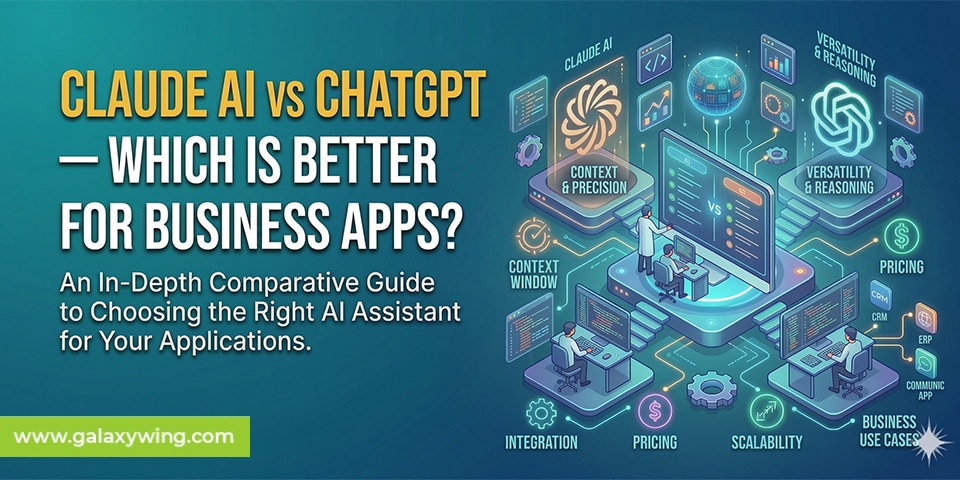
Artificial intelligence is no longer a futuristic concept — it is a core business tool. From automating customer support to generating marketing copy and analyzing contracts, large language models (LLMs) are reshaping how companies operate. Two models dominate the conversation: Anthropic’s Claude and OpenAI’s ChatGPT. But when it comes to Claude AI vs ChatGPT for business, which platform actually delivers more value?
The answer depends on your specific needs. In this in-depth comparison, we break down the strengths, limitations, pricing, and ideal use cases for both models so you can make a confident, informed decision for your organization.
Claude is developed by Anthropic, a company founded by former OpenAI researchers with a mission centered on AI safety. Claude is designed to be helpful, harmless, and honest. Its latest generation — Claude 4 — has earned a reputation for nuanced reasoning, long-context understanding, and a notably cautious approach to sensitive content. Claude is available through the Anthropic API, the Claude web and desktop apps, and Amazon Bedrock.
ChatGPT, built by OpenAI, is arguably the model that brought generative AI into the mainstream. Powered by the GPT-4o and o-series reasoning models, ChatGPT offers a broad ecosystem that includes plugins, image generation via DALL-E, web browsing, a code interpreter, and a massive third-party integration marketplace. It is available through the OpenAI API, the ChatGPT web and mobile apps, and Microsoft Azure OpenAI Service.
Before we dive into use cases, here is a side-by-side comparison of the features that matter most when evaluating Claude AI vs ChatGPT for business applications.
| Feature | Claude AI (Anthropic) | ChatGPT (OpenAI) |
|---|---|---|
| Latest Model | Claude Opus 4, Sonnet 4 | GPT-4o, o3, o4-mini |
| Context Window | Up to 1 million tokens | Up to 128K tokens (GPT-4o) |
| Safety & Alignment | Industry-leading; Constitutional AI approach | Strong; RLHF-based alignment |
| Reasoning & Analysis | Excellent; excels at nuanced, multi-step reasoning | Excellent; o3 model designed for deep reasoning |
| Coding Ability | Top-tier; Claude Code CLI for agentic development | Top-tier; built-in code interpreter & Codex agent |
| Multimodal Input | Text, images, PDFs, code files | Text, images, audio, video, files |
| Image Generation | Not available natively | DALL-E and GPT-4o native generation |
| Web Browsing | Available via tool use / integrations | Built-in browsing and search |
| API Pricing (Input) | From $0.25/M tokens (Haiku) to $15/M (Opus) | From $0.15/M tokens (4o-mini) to $15/M (o3) |
| API Availability | Anthropic API, Amazon Bedrock, Google Cloud | OpenAI API, Microsoft Azure OpenAI |
| Speed (Latency) | Fast; Haiku model optimized for speed | Fast; GPT-4o-mini optimized for speed |
| Plugin / Tool Ecosystem | Growing; MCP protocol for tool integration | Mature; GPT Store, plugins, Actions |
| Enterprise Features | SSO, admin console, data retention controls | SSO, admin console, ChatGPT Enterprise tier |
| Data Privacy | API data not used for training by default | API data not used for training by default |
Features on a spec sheet only tell part of the story. What really matters is how each model performs in the workflows your business depends on. Let us examine four critical use cases.
Both Claude and ChatGPT can power sophisticated customer-facing chatbots, but they have different strengths in this domain.
Claude stands out for its safety-first design. If your business operates in a regulated industry — healthcare, finance, legal — Claude’s Constitutional AI framework makes it less likely to produce harmful, misleading, or liability-creating responses. Its long context window also means it can ingest entire product manuals or policy documents and reference them accurately during a conversation without retrieval-augmented generation (RAG) in many cases.
ChatGPT excels when you need a chatbot that can do more than just answer text questions. With native web browsing, image understanding, and a rich plugin ecosystem, a ChatGPT-powered chatbot can look up live order statuses, interpret images a customer uploads, and integrate with dozens of third-party tools out of the box.
Verdict: Claude for safety-critical and document-heavy support; ChatGPT for feature-rich, multi-tool support experiences.
If you are looking to build a custom AI chatbot tailored to your business, Galaxywing’s chatbot development services can help you design, build, and deploy a solution using either model.
Marketing teams, content agencies, and e-commerce brands rely heavily on AI for copywriting, blog drafts, product descriptions, email campaigns, and social media content.
Claude produces writing that many users describe as more natural, nuanced, and less “robotic.” It tends to follow complex style guides faithfully and is particularly strong at long-form content where coherence over thousands of words matters. Its reluctance to generate sensationalized or misleading copy is an advantage for brands that prioritize trust.
ChatGPT is exceptionally versatile. It can generate text, create accompanying images with DALL-E, and browse the web to pull in current data points or statistics — all within a single workflow. For high-volume content operations that need speed and variety, ChatGPT’s broader toolset is a practical advantage.
Verdict: Claude for long-form, brand-safe, high-quality writing; ChatGPT for multimedia content workflows and speed at scale.
The debate around Claude AI vs ChatGPT for business software development is one of the most active in the developer community.
Claude has rapidly become a favorite among professional developers. Claude Code, Anthropic’s agentic coding tool, can autonomously navigate codebases, write and debug code, run tests, and even commit changes. Claude’s massive context window means it can understand an entire repository at once rather than working file-by-file. Independent benchmarks consistently rank Claude among the top models for code generation accuracy.
ChatGPT offers a built-in code interpreter that can execute Python code, generate visualizations, and process files in real time. OpenAI’s Codex agent provides similar agentic coding capabilities. ChatGPT’s integration with the broader OpenAI ecosystem — including GitHub Copilot, which is built on OpenAI models — gives it a significant footprint in the developer tools market.
Verdict: Both are excellent. Claude has an edge in understanding large codebases; ChatGPT has a broader developer ecosystem and built-in code execution.
Businesses deal with contracts, reports, compliance documents, and research papers daily. AI can dramatically accelerate document review.
Claude has a clear advantage here thanks to its industry-leading context window of up to 1 million tokens. That is roughly 3,000 pages of text in a single prompt. You can upload lengthy legal contracts, annual reports, or technical manuals and ask Claude to summarize, compare, or extract specific clauses — without chunking the document or losing context.
ChatGPT with its 128K context window can still handle substantial documents, and its file upload and code interpreter features allow it to process spreadsheets, PDFs, and data files effectively. However, for extremely long documents, you may need to split them across multiple interactions or implement RAG.
Verdict: Claude wins for long-document analysis. ChatGPT is sufficient for most standard-length business documents.
Cost is a critical factor when choosing an AI platform for business deployment, especially at scale.
Both Anthropic and OpenAI offer tiered pricing. For budget-conscious applications like high-volume chatbots, Claude’s Haiku model and OpenAI’s GPT-4o-mini offer comparable, affordable pricing. For premium reasoning tasks, Claude Opus and OpenAI’s o3 sit at similar price points.
The real cost difference often comes down to architecture choices. Claude’s larger context window can reduce the need for complex RAG infrastructure, potentially lowering your total system cost. On the other hand, ChatGPT’s built-in tools (browsing, code execution, image generation) can reduce the number of external services you need to integrate and pay for separately.
When evaluating Claude AI vs ChatGPT for business costs, look beyond per-token pricing. Factor in infrastructure, integration complexity, and the engineering time required to build and maintain your solution.
For CTOs and business leaders, the question of safety and compliance is non-negotiable.
Anthropic has built its entire brand around responsible AI. Claude’s Constitutional AI approach means the model is trained to self-correct against a set of principles, reducing the risk of harmful outputs. For businesses in regulated industries, this is a meaningful differentiator. Anthropic also offers enterprise plans with SSO, audit logs, and data retention controls.
OpenAI has invested heavily in enterprise features with ChatGPT Enterprise and the Azure OpenAI Service, which provides the compliance certifications (SOC 2, HIPAA eligibility, GDPR) that large organizations require. The Azure deployment option is particularly attractive for enterprises already embedded in the Microsoft ecosystem.
Both platforms commit to not training on API data by default, which is essential for any business handling proprietary or sensitive information.
There is no single “better” model — only the better model for your specific needs. Here is a practical decision framework.
Many forward-thinking businesses are adopting a multi-model strategy, routing different tasks to different models based on their strengths. For example, you might use Claude for document analysis and compliance-sensitive chatbots while using ChatGPT for multimedia content creation and customer-facing tools that need web access. This approach maximizes capability while managing cost and risk.
The Claude AI vs ChatGPT for business debate does not have a one-size-fits-all answer. Claude leads in safety, long-context understanding, and thoughtful reasoning. ChatGPT leads in ecosystem breadth, multimodal capabilities, and tool integrations. Both are excellent, production-ready platforms for business applications.
The most important factor is not which model you choose — it is how well you implement it. A poorly designed AI solution built on the “best” model will underperform a well-architected solution on either platform. The architecture, prompt engineering, data pipeline, and user experience design matter just as much as the underlying model.
Whether you are leaning toward Claude, ChatGPT, or a multi-model approach, Galaxywing can help you turn strategy into a production-ready application. Our team specializes in building custom AI solutions — from intelligent chatbots and virtual assistants to full-scale enterprise AI platforms.
We work with both Anthropic and OpenAI APIs and help you select the right model, design the architecture, and deploy a solution that delivers real business results.
Ready to get started?

As we forge ahead into an increasingly digital world, staying abreast of the latest IT trends is crucial for businesses and individuals alike. Embracing these cutting-edge technologies not only enh...
Read More

A website is crucial for a business for several reasons: Online Presence: In today's digital age, having an online presence is essential for businesses to reach and engage with customers. A we...
Read More 
Before hiring a website designer for your business, it is essential to consider several points to ensure you make the right choice. Here are some key factors to work on before hiring a website desi...
Read More 
Google's Quality Rater Guidelines play a vital role in shaping the search engine's algorithms and ensuring the delivery of high-quality, relevant search results. These guidelines help human quality...
Read More 
Improving website performance is crucial for enhancing user experience, increasing engagement, and boosting search engine rankings. Here are several ways to improve website performance: Optimi...
Read More 
Keywords are the building blocks of any successful online advertising campaign. Whether you're running pay-per-click (PPC) ads on platforms like Google Ads or creating content for search engine opt...
Read More At our core, we are dedicated to helping businesses flourish and achieve extraordinary sales growth. With over a decade of experience, we have been instrumental in empowering numerous organizations to thrive in their respective industries. What started as a small team with a modest vision has evolved into a formidable force of passionate professionals who are committed to design and excellence.
Since our establishment in 2015, we have consistently delivered exceptional results. Our team’s expertise, combined with our unwavering dedication, has enabled us to make a significant impact on the success of our clients. We understand the unique challenges businesses face and tailor our strategies and solutions to drive remarkable growth.
Our approach is built on collaboration, innovation, and a deep understanding of our clients’ goals. We work closely with businesses to develop customized strategies and implement cutting-edge solutions that yield tangible results. By leveraging our expertise, industry knowledge, and a relentless pursuit of excellence, we help businesses thrive in today’s competitive landscape.
As we look ahead, our commitment to helping businesses grow better remains unwavering. We will continue to evolve, adapt, and push boundaries to deliver even greater value to our clients. Together, let’s embark on a journey of growth, success, and unparalleled achievement.
Join us as we empower businesses to reach new heights of excellence.


 By Galaxywing IT Solutions
  Mar 9, 2026