


USA


Australia
USA
Australia
Our blog shares both our expertise and bit of company culture.
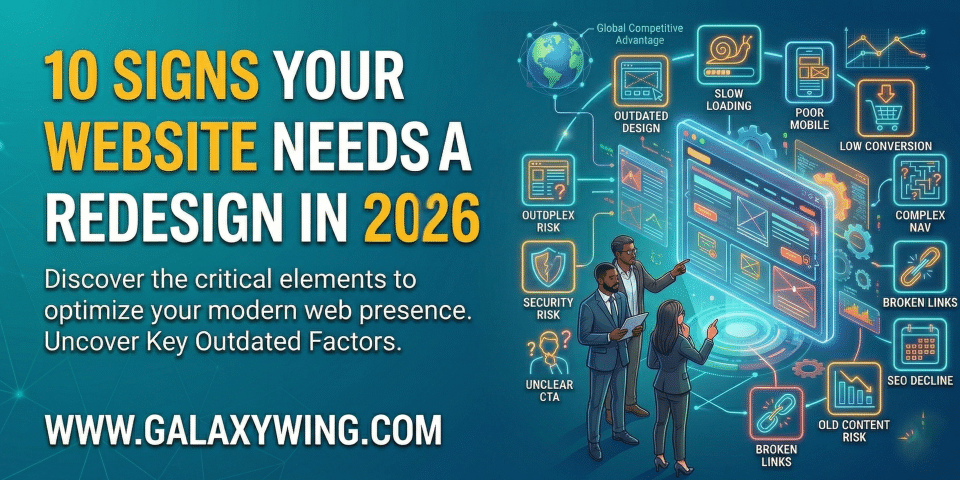
Your website is the front door to your business. If it looks outdated, loads slowly, or fails to convert visitors into customers, it is costing you money every single day. Here are the 10 unmistakable signs your website needs a redesign — and what to do about it.
For most US business owners, a website is not just a digital brochure. It is your hardest-working salesperson, your first impression, and often the deciding factor between winning a customer or losing them to a competitor. Yet according to a 2025 study by GoodFirms, 73.1% of web designers believe that a non-responsive design is the top reason visitors leave a website. If your site was built more than three or four years ago and has not been significantly updated, chances are it is actively hurting your business.
The web moves fast. Design trends evolve, Google updates its algorithm multiple times per year, mobile usage continues to climb, and user expectations keep rising. A website that worked perfectly in 2022 may feel sluggish, cluttered, and untrustworthy in 2026. The question is not whether your site will eventually need a redesign — it is whether you are already past due.
In this guide, we walk through the 10 clearest signs your website needs a redesign, explain why each one matters, and help you decide when it is time to invest in a modern, high-performing site.
Before we get into the warning signs, it is worth understanding the stakes. Your website is not just a nice-to-have — it directly impacts revenue, credibility, and growth. Consider these numbers:
If your website is underperforming in any of these areas, you are leaving money on the table. Let us look at the specific warning signs.
Page speed is no longer optional — it is a baseline expectation. Google has confirmed that site speed is a ranking factor, and users have even less patience than search engines. According to Google research, 53% of mobile visitors will leave a page that takes longer than 3 seconds to load. If your site takes 5, 8, or 10 seconds to fully render, you are hemorrhaging traffic before visitors even see your content.
Slow loading times are often caused by unoptimized images, bloated code, cheap hosting, too many plugins, or outdated frameworks. A modern redesign addresses all of these issues at the foundation level. Tools like Google PageSpeed Insights can give you a quick benchmark — if your score is below 50 on mobile, you have a serious problem that needs immediate attention.
Beyond user experience, slow sites cost you in advertising too. If you are running Google Ads or social media campaigns and sending paid traffic to a slow site, you are paying for clicks that never convert. Every fraction of a second matters.
In 2026, mobile devices account for approximately 60% of all global web traffic (Source: Statista). Google uses mobile-first indexing, meaning it primarily evaluates the mobile version of your website for ranking purposes. If your site is not fully responsive — meaning it does not seamlessly adapt to smartphones, tablets, and desktops — you are invisible to a majority of your potential customers.
A non-mobile-friendly site does not just look bad on phones. Text is too small to read, buttons are impossible to tap, images overflow the screen, and navigation menus break entirely. Users do not pinch and zoom anymore — they leave. And when they leave, Google notices. High bounce rates from mobile visitors send a clear signal that your content is not meeting user expectations, which pushes your rankings even lower.
If your website was built before responsive design became standard, or if it uses a separate “m.dot” mobile version, it is time for a ground-up redesign with a mobile-first approach.
Bounce rate measures the percentage of visitors who land on your site and leave without taking any action — no clicking, no scrolling, no engaging. While acceptable bounce rates vary by industry, a rate above 70% for most business websites is a red flag. For landing pages, anything above 90% signals a serious disconnect between what visitors expect and what they find.
High bounce rates typically stem from a combination of problems: slow loading, confusing navigation, unappealing design, irrelevant content, or aggressive pop-ups that drive people away. If your Google Analytics data shows a consistently high bounce rate across your key pages, it is one of the clearest signs your website needs a redesign. The design itself may be turning away the very people you are spending money to attract.
A professional redesign focuses on clear visual hierarchy, compelling above-the-fold content, intuitive navigation, and strategic calls to action — all of which work together to keep visitors engaged and moving toward conversion.
Web design trends change rapidly. If your site still features stock photos with watermarks, Flash elements, cluttered layouts, tiny fonts, auto-playing music, or a design aesthetic from the early 2010s, visitors will immediately question whether your business is still active and trustworthy. First impressions happen in 0.05 seconds (Source: Behaviour and Information Technology journal), and an outdated design makes the wrong one.
Modern web design in 2026 emphasizes clean layouts, generous white space, bold typography, high-quality imagery, subtle animations, dark mode compatibility, and accessibility-first principles. If your competitors have embraced these standards and you have not, visitors will naturally gravitate toward the sites that look more professional and current.
Think about it from your customer’s perspective. If you walked into a retail store with flickering lights, peeling wallpaper, and outdated signage, would you trust that business with your money? Your website creates the same psychological impression. An outdated design does not just look bad — it actively erodes trust and credibility.
Search engine optimization is deeply tied to your website’s technical structure, speed, content quality, and user experience. If your organic traffic has been flat or declining, your rankings are slipping, or you are nowhere to be found for keywords that matter to your business, your website’s architecture may be the root cause.
Common SEO problems that require a redesign include poor URL structures, missing or duplicate meta tags, slow server response times, no schema markup, broken internal links, unoptimized heading hierarchies, and content that has not been updated in years. Google’s algorithm now heavily weights Core Web Vitals — metrics that measure loading performance, interactivity, and visual stability. If your site fails these benchmarks, no amount of keyword stuffing or backlink building will save your rankings.
A modern redesign built with SEO best practices from the ground up gives you a fresh technical foundation. Clean code, fast hosting, proper heading structure, optimized images, structured data, and mobile responsiveness all contribute to better search visibility. If your site was built without SEO in mind, patching individual issues is often less effective than starting with a clean, optimized architecture.
This is perhaps the most important sign of all. Your website exists to serve your business goals — whether that means generating leads, booking appointments, selling products, or collecting email subscribers. If your traffic is decent but conversions are nearly nonexistent, your website’s design, messaging, or user flow is failing.
Common conversion killers include buried contact information, unclear value propositions, no compelling calls to action, too many form fields, lack of trust signals (testimonials, reviews, certifications), and confusing navigation that prevents visitors from finding what they need. According to HubSpot, companies with 10 to 15 landing pages see 55% more leads than those with fewer than 10. If your site has just a homepage, an about page, and a contact page, you are missing massive conversion opportunities.
A conversion-focused redesign maps every page to a specific business goal, places strategic CTAs throughout the user journey, highlights social proof, and removes friction from the path to purchase or inquiry. The difference between a site that generates 2 leads per month and one that generates 50 often comes down to design and user experience — not traffic volume.
Website security is non-negotiable in 2026. If your site still runs on HTTP instead of HTTPS, uses an outdated content management system, has not been patched in months, or relies on abandoned plugins, you are exposing your business and your customers to serious risk. Over 30,000 websites are hacked every single day (Source: Sophos), and small business sites are frequent targets because they tend to have weaker security.
Beyond the direct risk of data breaches and malware, security issues also impact your SEO and credibility. Google Chrome flags HTTP sites as “Not Secure” with a visible warning in the browser bar. Many users will immediately leave when they see that warning, especially if they are considering entering personal or payment information. Google also uses HTTPS as a ranking signal, meaning insecure sites are penalized in search results.
If your site is running on an outdated CMS version, uses deprecated PHP versions, or has known vulnerabilities that cannot be patched without a major overhaul, a redesign is the safest and most cost-effective path forward. Modern platforms and frameworks are built with security as a priority, including automatic updates, SSL certificates, firewalls, and regular vulnerability scanning.
A website that requires a developer for every small text change, image swap, or blog post is a website that will fall behind. Content freshness matters for SEO, and your ability to quickly update pricing, add new services, publish blog posts, or respond to market changes is critical for staying competitive.
If your site was custom-coded without a content management system, built on a platform you have outgrown, or uses a CMS so outdated that editing feels painful, you will avoid making updates. And a stale website sends the wrong message to both visitors and search engines. Google favors websites that are regularly updated with fresh, relevant content.
Modern website platforms give business owners full control over their content without touching a line of code. A well-executed redesign includes an intuitive admin panel where you can edit pages, publish blog posts, update images, manage products, and add new sections — all on your own. This independence saves you money on developer fees and ensures your site stays current.
If you do not know how many people visit your website, where they come from, which pages they view, how long they stay, or where they drop off, you are flying blind. Yet a surprising number of small business websites have no analytics installed at all — or have a Google Analytics setup that was never properly configured.
Without data, you cannot make informed decisions. You do not know if your marketing campaigns are working, which pages need improvement, what content resonates with your audience, or where your conversion funnel is leaking. According to McKinsey, data-driven organizations are 23 times more likely to acquire customers and 6 times more likely to retain them.
A redesign is the perfect opportunity to implement comprehensive tracking from day one. This includes Google Analytics 4, Google Search Console, conversion tracking, heatmaps, event tracking for button clicks and form submissions, and integration with your CRM or email marketing platform. When your new site launches with proper analytics baked in, every future marketing decision is backed by real data instead of guesswork.
Here is a simple test: open your website in one browser tab and your top three competitors in three other tabs. Switch between them honestly. If your competitors’ sites look more modern, load faster, have clearer messaging, and provide a better overall experience, your potential customers are noticing the same thing — and many of them are choosing your competitors as a result.
In competitive markets, your website is often the tiebreaker. When a potential customer is comparing two or three businesses that offer similar services at similar prices, the company with the better website wins. It signals professionalism, attention to detail, and investment in the customer experience. An outdated site, on the other hand, raises doubts about the quality of your products or services.
Staying competitive does not mean copying your competitors’ designs. It means ensuring your site meets or exceeds the current standards in your industry. A strategic redesign positions your brand as the premium choice in your market, with a design that communicates confidence, expertise, and trustworthiness.
As a general guideline, most businesses should plan for a significant website refresh every 2 to 3 years. This does not always mean a complete ground-up rebuild. Sometimes a targeted refresh — updating the visual design, improving page speed, adding new landing pages, or migrating to a faster hosting platform — is enough to stay current.
However, if your site is more than 4 years old and has not received major updates, a full redesign is almost certainly overdue. Technology, design standards, SEO best practices, and user expectations evolve too quickly for a five-year-old website to remain competitive.
The key is to view your website as a living asset that requires ongoing investment — not a one-time project you can set and forget. The businesses that treat their websites as dynamic, evolving tools consistently outperform those that let their sites stagnate.
If you have identified several of the warning signs above, you may be wondering what a proper redesign involves. Here is what a professional, results-driven website redesign includes:
Many business owners delay a redesign because of the upfront cost. But consider the cost of inaction. Every day your outdated website is live, you are losing potential customers to competitors with better sites. You are ranking lower in search results. You are paying for advertising that sends traffic to a site that does not convert. You are reinforcing a brand image that does not reflect the quality of your actual business.
A well-executed website redesign is not an expense — it is an investment with measurable returns. Businesses that invest in professional redesigns routinely see 30% to 100% increases in lead generation, significant improvements in search rankings, lower bounce rates, and stronger brand perception.
If you recognized your business in three or more of the signs above, it is time to take action. A professional website redesign does not have to be overwhelming or break the bank. The right partner will guide you through the entire process — from strategy and design to development, launch, and ongoing optimization.
At Galaxywing IT Solutions, we specialize in building fast, modern, SEO-optimized websites for US businesses that are ready to grow. Our team handles everything from initial strategy and wireframing to responsive design, development, analytics setup, and post-launch support. We build sites that do not just look great — they generate leads, rank in search engines, and give you full control over your content.
Whether you need a complete redesign or a targeted refresh, we would love to talk about what is possible for your business. Contact Galaxywing IT Solutions today for a free consultation and website audit. Let us build you a website that works as hard as you do.

In the realm of web development, HTML (HyperText Markup Language) serves as the bedrock upon which every successful website is built. Whether you're a seasoned developer or a newcomer to the world ...
Read More

Improving website performance is crucial for enhancing user experience, increasing engagement, and boosting search engine rankings. Here are several ways to improve website performance: Optimi...
Read More 
In the modern digital landscape, businesses strive to expand their audience and stay ahead of the competition. One effective approach to achieve these goals is through cross-platform app developmen...
Read More 
Artificial intelligence is no longer a futuristic concept — it is a core business tool. From automating customer support to generating marketing copy and analyzing contracts, large language models ...
Read More 
Your website is the front door to your business. Picking the wrong agency to build it can cost you months of lost revenue. Here are the 10 factors every small business owner should evaluate before ...
Read More 
In today's fast-paced world, the dominance of mobile devices has given rise to a mobile-first culture. Businesses are increasingly embracing mobile-optimized websites to ensure accessibility across...
Read More At our core, we are dedicated to helping businesses flourish and achieve extraordinary sales growth. With over 15 years of experience, we have been instrumental in empowering numerous organizations to thrive in their respective industries. What started as a small team with a modest vision has evolved into a passionate team of professionals committed to design and delivering results.
Our approach is built on collaboration, innovation, and a deep understanding of our clients’ goals. We work closely with businesses to develop customized strategies and implement solutions that yield tangible results. We understand the unique challenges businesses face and tailor our approach to drive meaningful growth.
As we look ahead, our commitment to helping businesses grow remains strong. We will continue to evolve, adapt, and deliver even greater value to our clients. Together, let’s embark on a journey of growth and success.


 By Galaxywing IT Solutions
  Apr 4, 2026